Ansoff matrix – product market grid
Introduction to the Ansoff matrix
The Ansoff product/ market matrix is a tool that helps businesses decide their product and market growth strategy.
Ansoff’s product/ market matrix suggests that a business’ attempts to grow depend on whether it markets new or existing products in new or existing markets.
The traditional four box grid or matrix Ansoff model

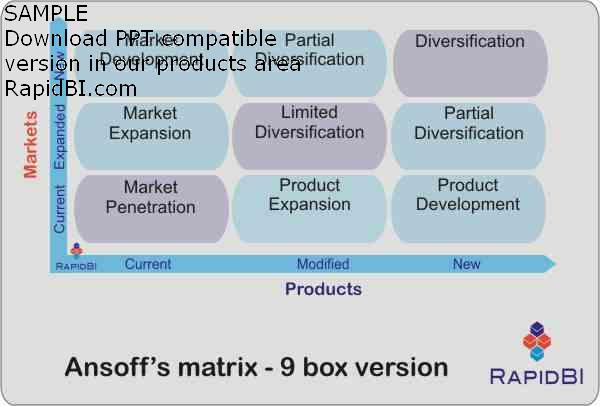
Alternative Ansoff style matrix
A revised version of the Ansoff matrix featuring a 3×3 or nine box grid or matrix.
History – The Product / Market Matrix
Igor Ansoff created the Product / Market diagram in 1957 as a method to classify options for business expansion. The simplisity of this model is that the four strategic options defined can be generically applied to any industry.
This well known marketing tool was first published in the Harvard Business Review (1957) in an article called ‘Strategies for Diversification’. It was consequently published in Ansoff’s book on “Corporate Strategy” in 1965.
About the Ansoff Matrix
It is used by marketers who have objectives for growth. Igor Ansoff’s matrix offers strategic choices to achieve the objectives. There are four main categories for selection.
- Market Penetration
- Market Development
- Product Development
- Business Diversification
The four main categories
Market Penetration (existing markets, existing products):
Here we market our existing products to our existing customers. This means increasing our revenue by, for example, promoting the product, repositioning the brand, and so on. However, the product is not altered and we do not seek any new customers.
Market penetration seeks to achieve four main objectives:
- Maintain or increase the market share of current products – this can be achieved by a combination of competitive pricing strategies, advertising, sales promotion and perhaps more resources dedicated to personal selling
- Secure dominance of growth markets
- Restructure a mature market by driving out competitors; this would require a much more aggressive promotional campaign, supported by a pricing strategy designed to make the market unattractive for competitors
- Increase usage by existing customers. For example by introducing loyalty schemes.
A market penetration marketing strategy is very much about “business as usual”. The business is focusing on markets and products it knows well. It is likely to have good information on competitors and on customer needs. It is unlikely, therefore, that this strategy will require much investment in new market research.
Market Development (new markets, existing products):
Here we market our existing product range in a new market. This means that the product remains the same, but it is marketed to a new audience. Exporting the product, or marketing it in a new region, are examples of market development.
Market development is the name given to a growth strategy where the business seeks to sell its existing products into new markets.
There are many possible ways of approaching this strategy, including:
- New geographical markets; for example exporting the product to a new country
- New product dimensions or packaging: for example
- New distribution channels
- Different pricing policies to attract different customers or create new market segments
Product Development (existing markets, new products):
This is a new product to be marketed to our existing customers. Here we develop and innovate new product offerings to replace existing ones. Such products are then marketed to our existing customers. This often happens with the auto markets where existing models are updated or replaced and then marketed to existing customers.
Business Diversification (new markets, new products):
This is where we market completely new products to new customers. There are two types of diversification, namely related and unrelated diversification. Related diversification means that we remain in a market or industry with which we are familiar.
The diversification can be divided again into horizontal, vertical and lateral diversification.
- The horizontal diversification is the extension of the production programme.
- The vertical diversification is the sales stage stored by products pre order.
- The lateral diversification is the sales of completely new products, which within the range of the technology and marketing in no connection.
Diversification is an inherently higher risk strategy because the business is moving into markets in which it has little or no experience.
For a business to adopt a diversification strategy, it must have a clear idea about what it expects to gain from the strategy and a transparent and honest assessment of the risks.
Using Ansoff matrix
There are many uses of the Ansoff matrix or grid for example:
‘Analysing and planning to meet customer needs and expectations’
Facts that are worth considering include:
- What strategy is your Organisation/your Dept. implementing now for it’s products/services – you will need to place products/services in an appropriate quadrant?
- Is this the right strategy in terms of meeting customer needs and expectations?
- Is implementation effective?
References
Ansoff, I., Strategies for Diversification, Harvard Business Review, Vol. 35 Issue 5, Sep-Oct 1957, pp.113-124
Important note
While Ansoff’s matrix is a useful model or framework for analysis or planning, in reality situations are rarely this clear cut. In many situations markets and products will straddle across the matrix. So like many other models – a useful framework within which to check a hypothesis – but not a rule to be followed.



 charles ross says
08/06/2012 at 10:48Thanks Mike R!
Ansoff matrix – product market grid http://t.co/hCX0Th63
 Mike Redwood says
08/06/2012 at 05:53RT @247tweet: Ansoff matrix – product market grid http://t.co/acsboCZI ..a basic marketing model. 1957
 Mike Redwood says
08/06/2012 at 05:53RT @247tweet: Ansoff matrix – product market grid http://t.co/ElbSJgcD ..a basic marketing model. 1957
 BrOy says
30/11/2011 at 19:22RT @rapidbi: – product market grid http://t.co/5JAiWljX
 theLBSS says
24/04/2011 at 13:00Useful entry from @rapidbi site- https://rapidbi.com/ansoffmatrix-productmarketgrid/