Deep Dive brainstorming technique, an innovative process for organizational development
Deep Dive brainstorming technique for business and organizations of all forms.

Deep dive brainstorming technique for organizational development
Team development using Deep Dive
A five step process for change
Using Hot Teams in a DeepDive process
Brainstorming technique DeepDive style
Six ways to stop brainstorming
Observing and listening to customers
Nouns and verbs – making them work for you
Process – organization – culture – leadership

Deep dive brainstorming technique for organizational development
What is DeepDive™?
DeepDive is a technique to rapidly immerse a group or team into a situation for problem solving or idea creation. It is often used for brainstorming product or process development.
Originally developed by the IDEO group (a learning design company) for rapid product development, the DeepDive technique is now widely and increasingly used for innovation not only in product development, but process improvement and customer service strategies. The method used by IDEO was documented by Andy Boynton and Bill Fischer (of International Institute of Management Development (IMD) business school), who latterly further enhanced the process and sold the rights to Deloitte Consulting in 2006.
This approach to innovation often focuses on four distinct areas: Process, Organization, Culture, and Leadership.
The key to a successful DeepDive session(s) is for participants to arrive with information about the needs of their customers – and most importantly an open mind of what they can offer and how they can meet clients needs and expectations.
Often DeepDive sessions are run off-site, this has the disadvantage of helping to ‘educate’ the participants that they can only think ‘off-site’. To help support and engender a spirit of creative thinking it is recommended that all DeepDive sessions occur on-site.
Deep Dive as a team development process
In the current climate it is simply not good enough for an individual team to achieve results. The application of the DeepDive methodology, can enable an organization to improve the performance of teams across the organization.
Not all teams are equal, and not all are effective. This can often result in lost opportunities and negative bottom-line impact for the organization.
In the situation when an organization is undergoing significant ‘change’, frustration with team performance has encouraged many organizations to employ “quick fix” solutions. This will often mean engaging additional resources from outside the organization (new staff, consultants, interim etc) to facilitate training and development activities as well as to make improvements in technology and available facilities. Despite these well intentioned solutions and the potential for substantial payback, truly high-performing teams are rare (Jon Katzenbach and Douglas Smith).
These quick fix solutions focus on Maslows hygiene factors rather than on what it takes to engender a high performing team. Providing the team the latest technology, an agenda, a facilitator, a timekeeper, a leader, and a sense of mutual respect does not necessarily mean that they will achieve the desired results. A clear goal, resources, expectations of success and developing that sense of synergy working towards Maslows “Self Actualisation” for the team and all of its members. This is what the DeepDive process is designed to do – when run and integrated to the organization as a whole.
Deep Dive – A five step process
- Understand the market/ client/ technology and constraints (internal & External SWOT analysis, PESTLE analysis and PRIMO-F analysis)
- Observe real people in real situations
- Visualise new-to-the-world concepts and ultimate customers
- Evaluate and refine prototypes
- Implement new concept for commercialisation
A typical Deep Dive brainstorming process
- Creation of Hot Teams to work on the opportunities/ problems (these teams work the process end to end)
- Brainstorming – of ideas and options in context of customer needs
- Rapid Prototyping of potential solutions
- Observing & Listening from Customers (internal and external)
- Thinking of products in terms of verbs, rather than nouns
Hot Teams in a Deep Dive process
Create teams to run the process through from beginning to end.
- Named Hot Teams – having a name builds identity
- Multidisciplinary. – this is about collaboration and participation
- Group leader is assigned based on their abilities to work with groups. – leadership is the corner stone of success in this context
Effective brainstorming technique
- Clarify the focus for the event
- Playful rules – this is about enabling – not disabling
- One conversation at a time
- Stay focused on the task
- Encourage wild ideas
- Go for quantity
- Be visual
- Defer judgment
- Build on the ideas of others
- Number your ideas – allows indexing later
- Build and jump – use flip-chart carousels – staying in one place too long limits ideas
- The space remembers – what has happened in it, going back from when it was constructed
- Stretch your mental muscles – challenge – get outside the box
- Get physical – keep moving, use AVK resources
Six ways to stop a brainstorm session
Producing new and good ideas, even in an ideal environment, is hard work. Here is a critical list of techniques to avoid to stopping the process in its tracks:
- Let the boss lead/ speak first
- Give everyone a turn and time equality
- Ask the experts only – they know best
- Go off-site – if you need a creative environment…
- No silly stuff- keep it business like and ‘straight’
- Write down everything – something important might get missed
Rapid Prototyping
Once the idea generation and capture phase is completed a number of ideas should be ‘prototypes’ to see how they may or may not work. An idea should not be progressed to implementation until it is been prototyped and tested along with a number of other ideas. This is a common mistake in many brainstorming processes.
Rapid prototyping involves putting brainstormed ideas together and building or trying out ideas, concepts or processes.
Trying or testing involved participants walking through or role playing customers, suppliers and other parties to test or explore the merits of the proposal.
At the centre of this approach, prototyping is an act of visual and interactive brainstorming. By making something, be it an object or a physical experience, you can ‘see’ and experience it in a new way. This approach suddenly makes ideas more tangibly, making your goal closer at the same time it highlights issues that weren’t obvious when it was merely just a good idea on a board or flip-chart.
Once you have decided on an idea to develop, it is time to start prototyping! This means making a quick model, a 3D sketch, to illustrate your idea.
Rules for Rapid Prototyping in innovation:
- Get solid quickly – many people can understand concepts better when presented with a solid model.
- Start Simple – it does not have to be production quality
- Work Rapidly- this is about concept – not accuracy
- Make it rough – the ‘neater’ it looks the more opportunity to critise the ‘look’
Allow 30-45 minutes to make your prototype model
Observing & Listening from Customers (internal and external)
Customers count – if they do not want your idea, product or service, why invest time effort and money in developing it?
So many products are invested in and developed when if is obvious (to those observing) there is no real need – just watch the typical ‘Dragons den’ programme.
Customers need to be involved right from the start – your real ‘experts’ are you customers…. not your ‘specialists’.
Think of products in terms of verbs rather than nouns
We talk of phones, TV’s, computers, Blackberry etc.
What we need to do in order to be more innovative is think about these objectives as.. Mobile Phoning, watching interactions, computing, mobile emailing etc.
To focus on the verb rather than the noun enables us to look at the process and outcome as one, rather than objects and tasks.
Process – Organization – Culture – Leadership
Process
Fail often in order to succeed sooner. Enlightened trial and error usually succeeds over the lone genius. Prototyping facilitates learning about the product, service or process.
Prototype multiple ideas on a small scale to demonstrate, build on something you can see, feel and experience.
Market research – engage end users – deadly if your customers are taken for granted; also immerse yourself in the associated product environment.
Organization
Flat structure focused on learning. No type-casting allowed.
Culture
Trust in team members is vital and central to this methodology.
Don’t always listen to the ‘boss’. Do the contrary!
Leadership
The team leader only facilitates, they are not the expert. Their role is solely to coach the process, but not involved in ideas. This allows freedom. This process is consistent.
Being innovative in a corporate environment
Robert Sutton in his book ‘Weird Ideas that Work’ states the following as approaches to explore in the development and journey towards being an innovative organization:
- Hire ‘Slow Learners’ (of the organizational code).
- Hire People Who Make You Uncomfortable, Even Those You Dislike.
- Hire People You (Probably) Don’t Need
- Use Job Interviews to Get Ideas, Not to Screen Candidates
- Encourage People to Ignore and Defy Superiors and Peers
- Find Some Happy People and Get them to Fight
- Reward Success and Failure, Punish Inaction
- Decide to Do Something That Will Probably Fail, Then Convince Yourself and Everybody Else That Success is Certain
- Think of Some Ridiculous or Impractical Things to Do, Then Plan to Do Them.
- Avoid, Distract, and Bore Customers, Critics, and Anyone Who Just Wants to Talk About Money
- Don’t Try to Learn Anything from People Who Seem to Have Solved the Problems You Face.
- Forget the Past, Especially Your Company’s Successes.
Resources for innovation
The Art of Innovation: Lessons in Creativity from IDEO, America’s Leading Design Firm. Kelley, Tom. Doubleday, 2001
The Innovation Equation: Building Creativity and Risk Taking in your Organization, Byrd, 2003, Wiley
Weird Ideas that Work: 11½ Practices for Promoting, Managing, and Sustaining Innovation. Sutton, Robert I. 2002. New York: Free Press
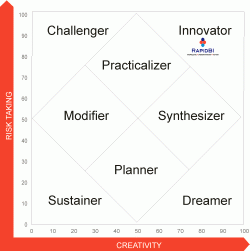
Creatrix and the Innovation Equation
Notes
The ‘DeepDive’ methodology is ™ and © Deloitte Consulting since they purchased the IP and © from IDEO.
Deep dive brainstorming technique for organizational development is a powerful tool and approach. Page reviewed March 2016



 SUAVE GODDI says
29/06/2012 at 09:39deep dive brainstorming organizational development. #article http://t.co/cuh4HaeI
 alex simpson says
11/06/2012 at 14:03@xavier_vidal DEEP DIVING RT @rapidbi: deep dive brainstorming organizational development http://t.co/nvKFSOyJ
 TheScorkle says
17/02/2012 at 01:12Deep diving on deep diving. http://t.co/MAVusHGD or do we mean scuba? #deepdive
 Craig Duncan says
17/02/2012 at 01:12Deep diving on deep diving. http://t.co/MAVusHGD or do we mean scuba? #deepdive
 Jacky kim says
12/12/2011 at 16:59What is similarities and differences between “deep dive” methodology and “lead user” methodology?
 Admin-Mike says
12/12/2011 at 18:48Very different – one is a brainstorming tool, the other is a market research approach. Both can work together
 Jacky kim says
12/12/2011 at 16:56if we use deep dive methodology to design service, not product, what problem will we face?
 Admin-Mike says
12/12/2011 at 18:47It should be the same as product – for a service is a process or product – I believe IDEO do use the methodology with service based organizations
 Duncan Brodie says
06/12/2011 at 07:19deep dive brainstorming organizational development – http://t.co/CHoodc5j
 theLBSS says
23/05/2011 at 13:00Selected entry from @rapidbi blog- https://rapidbi.com/deepdivebrainstormingorganizationaldevelopment/
 theLBSS says
02/04/2011 at 13:00Featured article from @rapidbi site- https://rapidbi.com/deepdivebrainstormingorganizationaldevelopment/