Room Layouts suitable for group training
So you are having a training session or meeting. Have you considered what layout would be best for you?
Have you ever had a meeting in a room that was in a different configuration from your usual format?
Was the meeting more or less effective than normal?
This guide can be used when you ‘book’ or hire a training or meeting room. Remember to state the layout and the number of participants required.
Importance of effective training room layout
Room layout should not just be set by the number of people required, but by the purpose of the event. What is it that you are looking to achieve?
Key factors: –Where is the centre of attention – Do people need to interact with each other? –Do you want people in groups without moving people around?
Lecture Theatre – Training or Meeting Room Layout Style
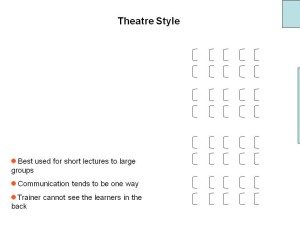
Advantages – If room is well designed, excellent visibility
Disadvantages – Poor trainer/ participant contact, Back rows should be elevated, University like
U Shape – Training or Meeting Room Layout Style
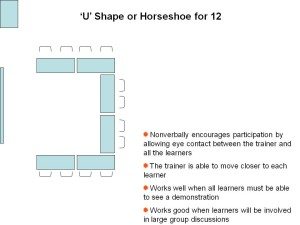
Advantages – Business Like, Trainer can walk into U shape, gaining direct contact with each person
Disadvantages – Formal, Front participants having to look at an angle
Seminar/ Amphitheatre – Training or Meeting Room Layout Style

Advantages and disadvantages as Lecture theatre
Herring Bone – Training or Meeting Room Layout Style

Advantages – Space effective for large numbers, All participants are at a good angle to the front, Trainer can walk down spine
Disadvantages – Several participants hidden by others, Reminiscent of school, Encourages dysfunctioning groups, Relatively poor contact
BoardRoom – Training or Meeting Room Layout Style

Advantages – Good for small groups, can see/ interact with others, can share resources, creates equality
Disadvantages – Difficult for some to ‘see the front’,
Circle or ’round’ – Training or Meeting Room Layout Style

Advantages – Creates Equality, Good for small groups, can see/ interact with others, can share resources
Disadvantages – Formal, participants having to look at an angle
Cabaret, Gala or Bistro – Training or Meeting Room Layout Style
 or
or 
Advantages – Good for larger numbers, Good for group work, Encourages mixing, Trainer or presenter can circulate
Disadvantages – Some participants will have poor visibility, May encourage lack of attention, Needs multimedia (PA & mic for best effect)
Training or Meeting Room Layout Summary
When you run your meeting or training event, it’s not just room layout that is important, it’s about matching the room layout with the trainers style, the material to be covered and the required outcomes. The room shape and design can make or break an event.
Computer training layouts
Depending on the nature of the room many
When setting up rooms for computer training be very aware of light reflections from windows and the ambient temperature and airflow in the room. A room with 8-10 people and computers can get very hot and very stuffy very quickly.
See some of our other posts on the Training room of the future
page updated June 2015 Updated May 2017



 Alexis Baker says
20/06/2012 at 16:52Training Room Layout http://t.co/dDJua0Nv via @rapidbi #hrthings
 Sue Davis says
05/12/2011 at 13:51Useful article for fellow training people on 'Training Room Layout' and how this affects teaching style http://t.co/rldpfCVS thanks @rapidbi
 Peter Ramsden says
02/02/2010 at 12:12Hi Mike,
My personal favourite is the U Shape. This allows a high level of interaction between facilitator and group.
My least favourite as a facilitator or a delegate is the herringbone or cabaret as this reminds me of school – not that I disliked school but I prefer to learn on an equal footing rather than teacher pupil.